April 2015 Triumph Triumph Again P 55

i | 2 | 3 | 4 | 5 | 6 | 7 Next
1 | 2 | 3 | iv | 5 | half dozen | vii Next
History
Siegfried Bettmann founded the Triumph Cycle Company in 1887 and promptly acquired premises in Coventry in which he began manufacturing bicycles. Equally technology advanced the visitor moved into the product of powered cycles in 1902. Past 1905 the manufactory output had reached 500 motorcycles per year, with the machines being designed, manufactured and built at the Coventry site.
For the side by side 18 years Triumph enjoyed steady growth and in 1923 the visitor added machine production to their portfolio. Past 1925 the motorcycle constitute in Coventry occupied 500,000-sq. ft. and employed 3000 people; with production at effectually 25-30,000 units per yr.
The motorbike industry remained adequately stable throughout the early 1930s, and in 1935 the decision was taken to split up the motorcar and motorcycle divisions (the bicycle business organization had been sold off in 1932). In due course the motorcycle arm was sold and renamed Triumph Applied science Co.
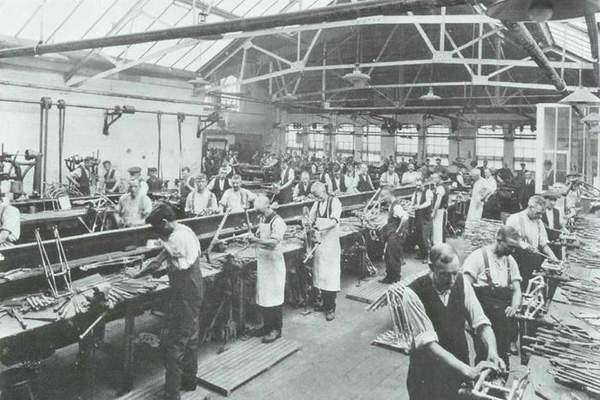
Triumph Coventry factory - framebuilders, 1935
During the second Earth War, the Government requisitioned virtually all of the machines manufactured and, despite the Coventry manufacturing plant existence destroyed in the 1942 Blitz of Coventry, product continued throughout the war years, firstly at a temporary site in Warwick and then at a new factory in Meriden.
Noncombatant production began once more in 1946 and with supply lines open over again Triumph set about re-establishing a dealer network in America. In 1951 the BSA group bought Triumph, although the Triumph marque was retained and the company remained a separate business within the group.
Production and sales had grown steadily since the war and past 1965 the Meriden plant was producing around 800 units per week, with lxxx% of these destined for the United states. Production peaked in 1969 at around 46,800 units per yr. In 1968 the get-go triple - the Triumph Trident - was produced (prior to this the company had concentrated on the manufacture of singles and twins).
By the early 70's the slow supply of parts, coupled with tooling problems led to production delays and in 1972, in a Government sponsored move, the BSA Group merged with Norton Villiers and Norton-Villiers-Triumph (NVT) was formed. In 1973 NVT announced that the Meriden plant was to close - which provoked a workers' sit down in. As a issue production ground to a halt and in the following year, 1974, virtually no motorcycles were built. In 1975, afterward much negotiation, the Meriden Workers Co-operative was formed and, with uppercase provided by way of a grant from the British government, production of 750cc Bonnevilles and Tigers resumed at the plant. The co-operative subsequently bought the rights to the Triumph marque from NVT and production gradually crept up to 350 units per week. Despite further support from the regime the co-operative went into liquidation in 1983.
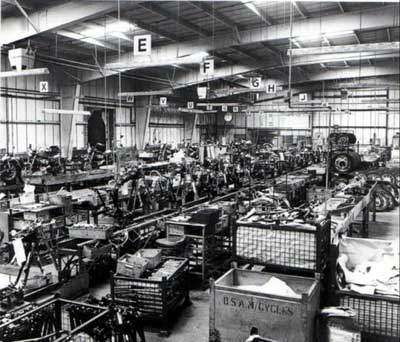
Triumph Meriden factory warehouse, early on 1970's
REBUILDING THE MARQUE
The intellectual property rights to the Triumph marque were after bought by John Bloor. Thus began the current era of Hinckley built Triumphs.
The new visitor needed a strong and stable platform from which a range of competitive motorcycles could be developed, thus the concept of the modular range was born. This concept enabled the range to share common components, thus allowing a number of different types of auto to be constructed from the same base of operations which, crucially, could all be built on one assembly line at the same time.
Blueprint of the new range commenced in 1984 and by 1988 the company was set to begin building a new factory (the quondam establish at Meriden had been demolished in the early 80s). A 10-acre site was purchased in Hinckley, Leicestershire, England and construction commenced. As presently as the offset phase of the site was complete, pre-production began and the first models were launched at the Cologne show of 1990. Production of the showtime new model - the 4-cylinder 1200cc Trophy - began in early 1991, with the mill initially building 8 - 10 new machines per mean solar day.
As production chapters steadily grew, Triumph ready about re-establishing a network of export distributors. Two subsidiary companies had been established to prior to product commencing; Triumph Federal republic of germany GmbH and Triumph France SA and over the next couple of years the network expanded to encompass virtually of the Earth'due south major motorcycle markets, culminating in 1994 with the creation of Triumph Motorcycles America Ltd.
By this fourth dimension 20,000 new Triumphs had been built and in January 1995 the Triple Connection vesture range and the accessories range of products were launched to provide the Triumph customer with an all-round packet of Triumph clothes and equipment.
The model range evolved throughout the early on nineties through a combination of refinements to the existing range together with the introduction of new models such as the Tiger, Trident Sprint, Speed Triple and Thunderbird.
By 1995 production stood at around 12,000 units a yr and as both retail sales and production capacity grew the company was able to develop more single-minded machines that did non rely on the modular concept. The first of these, the Daytona T595 and the T509 Speed Triple, were launched at the 1996 Cologne Show. Since then the range has diversified further with the introduction of the Sprint RS and ST, the Tiger and more than recently with the launch of the TT600 and Hinckley�s starting time twin, the Bonneville. Other models, such as the Daytona T595, Speed Triple, Tiger and Thunderbird have as well undergone significant redevelopment in the intervening years.
Production has steadily increased each yr and in anticipation of achieving the maximum chapters capable at the original factory, planning permission for a new factory was sought in the mid-�90s. The structure of Phase Ane of �Triumph 2� was completed in the autumn of 1999 and the transfer of sure manufacturing processes to the new plant ensued. Assembly however remained at the original constitute � at present referred to as Factory 1 � and past the beginning of 2001 the product line was building around 150 units per day � the maximum that could exist achieved from this facility.
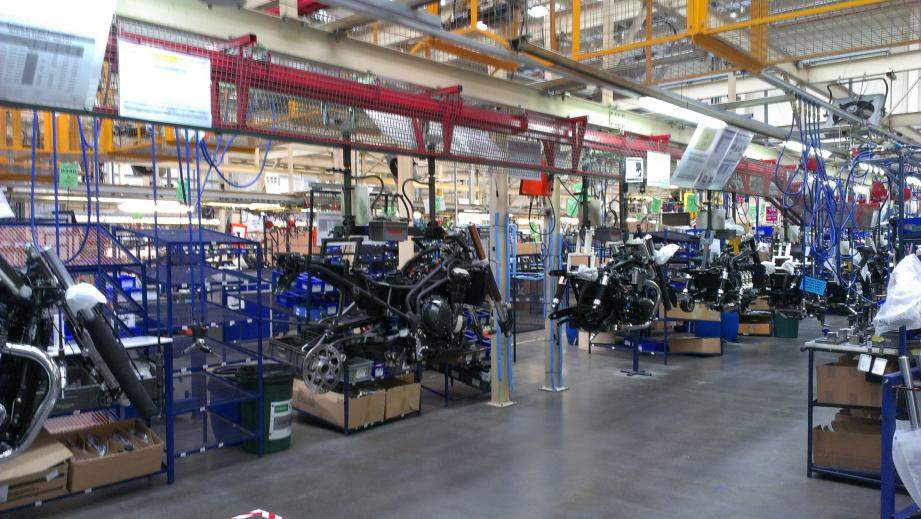
Modern era Triumph manufacturing plant
Planned product for 2002 was approximately 37,000 motorcycles, however this was halted in March 2002 by a fire that struck Factory one. The fire, which took v hours to bring under control, destroyed the chassis assembly line and stores expanse and coated much of the rest of the site in a layer of soot. The assembly and stores area were promptly demolished in preparation for rebuilding whilst a huge clean-upwardly functioning of the rest of the plant, which included two engine machining lines, the engine associates line and the paint shop enabled the factory to be swiftly operational once more.
Triumph Factory 2, together with the buildings housing the design, evolution, spares, clothing, accessories and bike storage functions were unaffected by the burn and continued to operate as normal.
The rebuilding of Factory 1 took v months, during which time no motorcycles were congenital. During this time, Triumph took the opportunity to relocate various manufacturing processes within Factory ii. Non only did this help to minimise the amount of production time lost but it besides allowed Triumph to review the most efficient layout for each process. Production recommenced in September 2002 and the plant is now dorsum to producing around 150 units per day.
Triumph at present has at its disposal i of the most mod motorcycle manufacturing facilities in the earth. This, together with our diverse model range and proactive model development programme, places Triumph firmly at the forefront of motorcycling.
CHRONOLOGY
1984 - The new company is founded and piece of work commences on the new modular range.
1988 - The x acre Hinckley site is purchased and structure commences.
1990 - The get-go phase of the factory is complete and pre-production starts.
SEPTEMBER 1990 - The earth launch of the first 6 models takes place at the Cologne Motorcycle Testify in Germany.
Feb 1991 - Production of the Triumph 4-cylinder 1200 Trophy commences.
MARCH 1991 - The starting time motorcycles are shipped to Germany, followed by distribution in Uk.
JUNE 1991 - The offset 3-cylinder models, the 750 Daytona and 900 Trophy, are manufactured.
OCTOBER 1991 - Farther export markets including Holland, Australia and French republic receive their first bikes.
January-JUNE 1992 - Distributors for many new export markets including Italy, Kingdom of spain, Switzerland and Japan are appointed.
OCTOBER 1992 - Triumph Britain accept delivery of the 5,000th bike produced, a Trophy 900.
OCTOBER 1992 - The Daytona 900, Tiger and Dart models are launched at the Cologne Show, Germany.
Nov 1992 - The 147PS Daytona 1200 is launched at the Birmingham Show, England.
Feb 1993 - Almost 40 German language dealers visit the Triumph manufacturing plant to ride home the first Daytona 900/1200 models, defying snow and water ice to launch the new models.
MARCH-MAY 1993 - Further export markets, including Sweden, receive their first bikes.
JULY 1993 - Triumph United kingdom accept delivery of the 10,000th bike produced, a Sprint 900.
SEPTEMBER 1993 - The Speed Triple and Super III are launched at the Paris Prove, France bringing the line-up to 10 models.
Jan 1994 - Triumph launch in Canada at the Toronto Prove.
FEBRUARY 1994 - Triumph's plans to expand their production capacity into the side by side century are S.E.cured by the granting of planning permission for a new mill on a 40-acre site.
MARCH 1994 - Triumph Motorcycles America Ltd is established and planning proceeds towards a 1995 product launch.
JULY 1994 - Triumph Motorcycles render to motorbike sport with the inaugural 'Speed Triple Challenge Race' at the British Thousand Prix, Donington Park, England.
OCTOBER 1994 - Triumph launch the long and eagerly awaited Thunderbird model at the Cologne Show, Germany.
Triumph re-enters the USA, completing their render to all the globe's major motorbike markets.
Triumph France take delivery of the 20,000th bike produced, a Dart 900.
Jan 1995 - Launch of the Triple Connection article of clothing and Triumph accessory ranges.
APRIL 1995 - Triumph Motorcycles Great britain launch the Mobil I Speed Triple Race Series.
JUNE 1995 - Triumph Motorcycles USA launch the Transatlantic Speed Triple Challenge Race Series.
New distributors are appointed for South Africa and Singapore.
Baronial 1995 - Triumph Australia accept delivery of the thirty,000th wheel produced, a Thunderbird.
SEPTEMBER 1995 - The completely restyled and redesigned Bays 900/1200 and the all new Charlatan models are launched at the Paris Show, France.
A UK passenger completes 250 000 miles on his Trident 900 - equivalent to one trip to the moon.
APRIL 1996 - Triumph Commonwealth of australia have delivery of the 40,000th bike produced, a Trophy 1200.
SEPTEMBER 1996 - Triumph launch their own Hinckley based owner's society named 'Riders Association of Triumph'.
Distributors for Malaysia and Thailand are appointed.
OCTOBER 1996 - Launch of the stunning new supersports bikes, the T509 Speed Triple and T595 Daytona, at the Cologne Show, Germany.
Jan 1997 - Production of the T500 Southward.E.ries of models starts. They are the most eagerly awaited Triumphs ever produced.
MARCH 1997 - Triumph UK accept delivery of the 50,000th bike produced, a Daytona T595.
MAY 1997 - Nick Sanders completes the fastest ever journeying around the globe on a motorcycle - 19,930 miles in
31 days 20 hours on a Daytona 900.
SEPTEMBER 1997 - Thunderbird Sport and Sprint Executive launched at the Milan Show, Italy.
OCTOBER 1997 - Triumph is awarded Motorcycle Manufacturer of the Year by the Motor Cycle News.
NOVEMBER 1997 - Triumph USA take commitment of the 60,000th bike produced, a Thunderbird Sport.
MARCH 1998 - A T595 wins the Pro Thunder race at Daytona Race Week.
MAY 1998 - Aimed at both novice and experienced riders, the new Legend TT is launched.
JUNE 1998 - Triumph France take commitment of the 70,000th bike produced, a Trophy 1200.
SEPTEMBER 1998 - At the Munich show, Triumph unveils the new Dart ST and a completely redesigned Tiger.
JANUARY 1999 - Triumph America take delivery of the 80,000th bicycle produced, a Daytona 955i.
Apr 1999 - Structure of the get-go phase of Triumph's new mill begins.
JULY 1999 - The ninety,000th bike rolls of the production line - an Italian Speed Triple.
SEPTEMBER 1999 - Launch of Triumph�s versatile new sports bike, the Sprint RS, at the Milan evidence.
October 1999 - Structure of stage one of the new mill is complete and the first production team � the weld shop � moves to its new home.
NOVEMBER 1999 - The eagerly awaited TT600 is unveiled at the International Motorcycle Show, Birmingham
JANUARY 2000 - The manufactory builds the 100,000th bike � an Lucifer Orange Sprint RS, destined for Italia
Source: https://www.motorcyclespecs.co.za/bikes/triumph.html
0 Response to "April 2015 Triumph Triumph Again P 55"
Post a Comment