Mahammad and His Message Guided Reading True of False
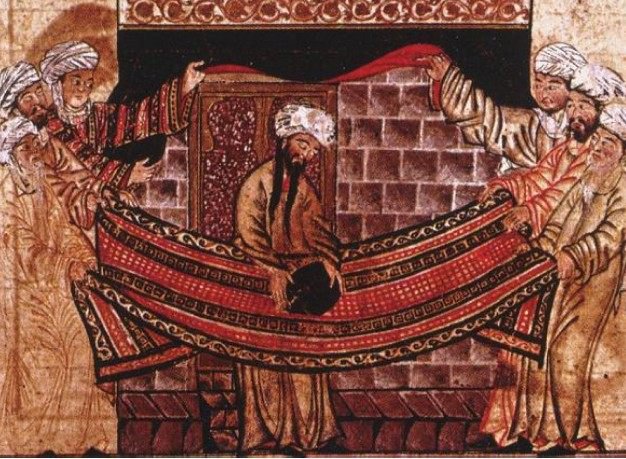
It is notoriously difficult to know anything for certain well-nigh the founder of a world organized religion. Just as one shrine later on the other obliterates the contours of the localities in which he was active, so ane doctrine after some other reshapes him equally a effigy for veneration and simulated for a vast number of people in times and places that he never knew.
In the case of Mohammed, Muslim literary sources for his life just brainstorm effectually 750-800 CE (common era), some four to five generations after his death, and few Islamicists (specialists in the history and written report of Islam) these days assume them to be straightforward historical accounts. For all that, nosotros probably know more nearly Mohammed than we do nigh Jesus (allow alone Moses or the Buddha), and nosotros certainly have the potential to know a great bargain more.
At that place is no doubt that Mohammed existed, occasional attempts to deny information technology notwithstanding. His neighbours in Byzantine Syrian arab republic got to hear of him within ii years of his death at the latest; a Greek text written during the Arab invasion of Syrian arab republic betwixt 632 and 634 mentions that "a simulated prophet has appeared among the Saracens" and dismisses him as an impostor on the basis that prophets do non come up "with sword and chariot". Information technology thus conveys the impression that he was really leading the invasions.
Mohammed's death is normally placed in 632, but the possibility that information technology should be placed two or 3 years after cannot be completely excluded. The Muslim calendar was instituted after Mohammed's expiry, with a starting-bespeak of his emigration (hijra) to Medina (then Yathrib) ten years earlier. Some Muslims, however, seem to have correlated this point of origin with the yr which came to span 624-5 in the Gregorian calendar rather than the canonical year of 622.
If such a revised date is authentic, the evidence of the Greek text would mean that Mohammed is the only founder of a earth organized religion who is attested in a contemporary source. Just in any example, this source gives us pretty irrefutable bear witness that he was an historical figure. Moreover, an Armenian document probably written shortly after 661 identifies him past name and gives a recognisable account of his monotheist preaching.
Patricia Crone is professor of Islamic history at the Institute for Avant-garde Study, Princeton. Her publications most relevant to this article include Meccan Trade and the Rise of Islam (Princeton University Press, 1987 [reprinted 2004]; "How did the quranic pagans make a living?" (Bulletin of the School of Oriental and African Studies (68 / 2005); and "Quraysh and the Roman Army: Making Sense of the Qurashi Leathertrade" (Bulletin of the School of Oriental and African Studies, forthcoming [spring 2007]).
Patricia Crone's main recent piece of work is Medieval Islamic Political Idea ( Edinburgh University Press, 2004) ; published in the United States as God's Rule: Authorities and Islam [ Columbia University Printing, 2004 ])
On the Islamic side, sources dating from the mid-8th century onwards preserve a certificate drawn upwards betwixt Mohammed and the inhabitants of Yathrib, which there are good reasons to have as broadly authentic; Mohammed is also mentioned by proper noun, and identified as a messenger of God, four times in the Qur'an (on which more than below).
Truthful, on Arabic coins and inscriptions, and in papyri and other documentary show in the language, Mohammed only appears in the 680s, some fifty years later his death (whatever its exact date). This is the basis on which some, notably Yehuda D Nevo and Judith Koren, have questioned his existence. But few would take the unsaid premise that history has to be reconstructed on the sole basis of documentary evidence (i.e. information which has not been handed down from one generation to the next, but rather been inscribed on stone or metal or dug up from the ground and thus preserved in its original grade). The evidence that a prophet was active amongst the Arabs in the early decades of the 7th century, on the eve of the Arab conquest of the middle east, must be said to be exceptionally adept.
Everything else well-nigh Mohammed is more uncertain, only we can still say a fair amount with reasonable assurance. Most chiefly, we can be reasonably sure that the Qur'an is a collection of utterances that he made in the belief that they had been revealed to him by God. The volume may not preserve all the messages he claimed to take received, and he is non responsible for the arrangement in which we have them. They were collected after his death – how long after is controversial. But that he uttered all or most of them is difficult to uncertainty. Those who deny the being of an Arabian prophet dispute it, of course, but it causes too many problems with after evidence, and indeed with the Qur'an itself, for the attempt to be persuasive.
The text and the message
For all that, the book is hard to utilise as a historical source. The roots of this difficulty include unresolved questions about how it reached its classical form, and the fact that it withal is non available in a scholarly edition. But they are besides internal to the text. The earliest versions of the Qur'an offer but the consonantal skeleton of the text. No vowels are marked, and worse, at that place are no diacritical marks, so that many consonants tin besides exist read in a number of ways.
Modern scholars usually assure themselves that since the Qur'an was recited from the get-go, we tin can rely on the oral tradition to supply us with the correct reading. But in that location is often considerable disagreement in the tradition – usually to do with vowelling, merely sometimes involving consonants besides – over the correct fashion in which a word should exist read. This rarely affects the overall pregnant of the text, but it does affect the details which are and then important for historical reconstruction.
In any case, with or without doubtfulness over the reading, the Qur'an is ofttimes highly obscure. Sometimes it uses expressions that were unknown even to the earliest exegetes, or words that do not seem to fit entirely, though they tin exist made to fit more or less; sometimes it seems to give us fragments detached from a long-lost context; and the style is highly allusive.
1 caption for these features would be that the prophet formulated his message in the liturgical language current in the religious community in which he grew upward, adapting and/or imitating ancient texts such equally hymns, recitations, and prayers, which had been translated or adjusted from another Semitic language in their turn. This thought has been explored in two German works, by Günter Lüling and Christoph Luxenberg, and there is much to be said for information technology. At the same time, however, both books are open to and then many scholarly objections (notably amateurism in Luxenberg'due south example) that they cannot exist said to have done the field much skillful.
The endeavor to relate the linguistic and stylistic features of the Qur'an to those of earlier religious texts calls for a mastery of Semitic languages and literature that few today possess, and those who practice so tend to work on other things. This is sensible, perhaps, given that the field has become highly charged politically.
Luxenberg's work is a case in point: it was picked up by the press and paraded in a sensationalist vein on the strength of what to a specialist was its worst idea – to instruct Muslims living in the west that they ought to become enlightened. Neither Muslims nor Islamicists were tickled.
The inside story
The Qur'an does not give us an account of the prophet'southward life. On the contrary: it does not show united states of america the prophet from the exterior at all, but rather takes united states of america within his caput, where God is speaking to him, telling him what to preach, how to react to people who poke fun at him, what to say to his supporters, and so on. We come across the world through his eyes, and the allusive style makes it difficult to follow what is going on.
Events are referred to, but not narrated; disagreements are debated without beingness explained; people and places are mentioned, but rarely named. Supporters are simply referred to as believers; opponents are condemned as unbelievers, polytheists, wrongdoers, hypocrites and the similar, with just the barest information on who they were or what they said or did in concrete terms (rather as modern political ideologues volition reduce their enemies to abstractions: revisionists, reactionaries, capitalist-roaders, terrorists). It could be, and sometimes seems to exist, that the same people now appear nether ane label then another.
I thing seems clear, even so: all the parties in the Qur'an are monotheists worshipping the God of the Biblical tradition, and all are familiar – if rarely direct from the Bible itself – with Biblical concepts and stories. This is truthful even of the so-called polytheists, traditionally identified with Mohammed'due south tribe in Mecca. The Islamic tradition says that the members of this tribe, known equally Quraysh, were believers in the God of Abraham whose monotheism had been corrupted past pagan elements; modern historians would be inclined to reverse the relationship and cast the pagan elements as older than the monotheism; but some kind of combination of Biblical-blazon monotheism and Arabian paganism is indeed what one encounters in the Qur'an.
The and so-called polytheists believed in one creator God who ruled the world and whom one approached through prayer and ritual; in fact, like the anathematised ideological enemies of modern times, they seem to accept originated in the same community equally the people who denounced them. For a variety of doctrinal reasons, however, the tradition likes to stress the pagan side of the prophet's opponents, and one highly influential source in particular (Ibn al-Kalbi) casts them as naive worshippers of stones and idols of a blazon that may very well take existed in other parts of Arabia. For this reason, the secondary literature has tended to depict them as straightforward pagans too.
Some exegetes are considerably more sophisticated than Ibn al-Kalbi, and among modern historians GR Hawting stands out equally the first to have shown that the people denounced as polytheists in the Qur'an are annihilation but straightforward pagans. The fact that the Qur'an seems to record a split in a monotheist community in Arabia can be expected to transform our understanding of how the new religion arose.
The prophet and the polytheists
What then are the big issues dividing the prophet and his opponents? Two stand up out. First, time and again he accuses the polytheists of the same criminal offence as the Christians – deification of lesser beings. The Christians elevated Jesus to divine condition (though some of them were believers); the polytheists elevated the angels to the same status and compounded their mistake by casting them (or some of them) as females; and just equally the Christians identified Jesus as the son of God, so the polytheists chosen the angels sons and daughters of God, apparently implying some sort of identity of essence.
The polytheists farther claimed that the angels (or deities, equally they are as well called) were intercessors who enabled them to arroyo God, a well-known argument by tardily antique monotheists who retained their ancestral gods by identifying them equally angels. For Christians also saw the angels as intercessors, and the prophet was of the same view: his polemics arise entirely from the fact that the pagan angels are seen every bit manifestations of God himself rather than his servants. The prophet responds past incessantly affirming that God is ane and alone, without children or anyone else sharing in his divinity.
The second os of contention between the prophet and his opponents was the resurrection. Some doubted its reality, others denied it outright, still others rejected the idea of afterlife birthday. The hardliners announced to have come up from the ranks of the Jews and/or Christians rather than - or in addition to - the polytheists; or possibly the and so-called polytheists were really Jews or Christians of some local kind. In any case, the hardliners convey the impression of having made their appearance quite recently, and again people of the same type are attested on the Greek (and Syriac) side of the contend.
The prophet responds past repeatedly rehearsing arguments in favour of the resurrection of the type familiar from the Christian tradition, insisting that people will be raised up for judgment. He adds that the judgment is coming before long, in the form of some local disaster such equally those which overtook earlier communities (e.g. Lot'due south) and/or a universal conflagration. His opponents tease him, asking him why information technology does non seem to be happening; he persists. At some indicate the confrontation turns vehement and the book is filled with calls to arms, with much fighting over a sanctuary.
Past then information technology is clear that there has been an emigration (hijra), though the outcome itself is not described, and in that location is some legislation for the new community. Throughout the volume in that location is as well much acrimonious debate about the credentials of the prophet himself. But God'south unity, the reality of the resurrection and judgment, and the imminence of trigger-happy penalisation are by far the most important themes, reiterated in most of the sura (capacity of the Qur'an).
In sum, not only do we know that a prophet was agile among the Arabs in the early on decades of the 7th century, nosotros also take a fair idea of what he preached. Not-Islamicists may therefore conclude that the historians' complaint that they know so little most him is mere professional grumpiness. Only on ane issue information technology is unquestionably more than. This is a big problem to practice with Arabia.
A question of geography
The inhabitants of the Byzantine and Persian empires wrote about the northern and the southern ends of the peninsula, from where nosotros also accept numerous inscriptions; but the centre was terra incognita. This is precisely where the Islamic tradition places Mohammed's career. Nosotros practice not know what was going on in that location, except insofar as the Islamic tradition tells united states.
Information technology yields no literature to which nosotros can relate the Qur'an – excepting poetry, for which we are again dependent on the Islamic tradition and which is in any instance so different in character that it does not throw much light on the book. Not a single source exterior Arabia mentions Mecca before the conquests, and not i displays any sign of recognition or tells united states of america what was known about information technology when it appears in the sources thereafter. That there was a place called Mecca where Mecca is today may well be true; that it had a pagan sanctuary is perfectly plausible (Arabia was total of sanctuaries), and it could well have belonged to a tribe called the Quraysh. Just we know nothing about the place with annihilation budgeted reasonable certainty. In sum, we have no context for the prophet and his message.
It is difficult not to suspect that the tradition places the prophet's career in Mecca for the aforementioned reason that it insists that he was illiterate: the merely style he could have acquired his knowledge of all the things that God had previously told the Jews and the Christians was by revelation from God himself. Mecca was virgin territory; it had neither Jewish nor Christian communities.
The suspicion that the location is doctrinally inspired is reinforced by the fact that the Qur'an describes the polytheist opponents as agriculturalists who cultivated wheat, grapes, olives, and appointment palms. Wheat, grapes and olives are the three staples of the Mediterranean; date palms take u.s. southwards, merely Mecca was not suitable for whatsoever kind of agronomics, and ane could not perhaps take produced olives there.
In addition, the Qur'an twice describes its opponents as living in the site of a vanished nation, that is to say a town destroyed by God for its sins. There were many such ruined sites in northwest Arabia. The prophet frequently tells his opponents to consider their significance and on one occasion remarks, with reference to the remains of Lot'due south people, that "you lot pass by them in the morning and in the evening". This takes u.s. to somewhere in the Expressionless Sea region. Respect for the traditional account has prevailed to such an extent among modern historians that the beginning two points have passed unnoticed until quite recently, while the third has been ignored. The exegetes said that the Quraysh passed by Lot's remains on their annual journeys to Syrian arab republic, but the just way in which one can pass past a place in the morning and the evening is plain by living somewhere in the vicinity.
The annual journeys invoked by the exegetes were trading journeys. All the sources say that the Quraysh traded in southern Syria, many say that they traded in Yemen likewise, and some add Iraq and Ethiopia to their destinations. They are described equally trading primarily in leather goods, woollen wear, and other items of by and large pastoralist origin, as well as perfume (not south Arabian frankincense or Indian luxury goods, as used to be idea). Their caravan trade has been invoked to explain the familiarity with Biblical and para-Biblical cloth which is and so marked a feature of the Qur'an, simply this goes well beyond what traders would be likely to pick upwardly on annual journeys. There is no doubt, however, that one way or the other a trading community is involved in the rising of Islam, though it is not articulate how it relates to that of the agriculturalists of the Qur'an. On all this in that location is much to be said, if not yet with any certainty.
Three sources of testify
The biggest problem facing scholars of the rise of Islam is identifying the context in which the prophet worked. What was he reacting to, and why was the rest of Arabia then responsive to his bulletin? Nosotros stand a skillful risk of making headway, for we are nowhere most having exploited to the total our three main types of evidence – the traditions associated with the prophet (primarily the hadith), the Qur'an itself, and (a new source of enormous promise) archaeology.
The first is the almost difficult to handle; this overwhelmingly takes the course of hadith – short reports (sometimes but a line or two) recording what an early figure, such as a companion of the prophet or Mohammed himself, said or did on a detail occasion, prefixed by a concatenation of transmitters. (Present, hadith almost always means hadith from Mohammed himself.) Most of the early sources for the prophet's life, as also for the period of his immediate successors, consist of hadith in some organization or other.
The purpose of such reports was to validate Islamic law and doctrine, not to record history in the modern sense, and since they were transmitted orally, as very short statements, they hands drifted away from their original meaning as conditions inverse. (They were also easily fabricated, just this is really less of a problem.) They bear witness to intense conflicts over what was or was not truthful Islam in the period up to the ninth century, when the fabric was collected and stabilised; these debates obscured the historical nature of the figures invoked as authorities, while telling us much about later on perceptions.
The material is amorphous and difficult to handle. Merely to collect the huge mass of variant versions and alien reports on a item discipline used to be a laborious task; now it has been rendered practically effortless past searchable databases. However, nosotros still do not have mostly accustomed methods for ordering the textile, whether equally evidence for the prophet or for the afterward doctrinal disputes (for which it will probably prove more fruitful). But much interesting work is going on in the field.
As regards the 2nd source, the Qur'an, its written report has and then far been dominated by the method of the early on Muslim exegetes, who were in the habit of considering its verses in isolation, explaining them with reference to events in the prophet's life without regard for the context in which it appeared in the Qur'an itself. In issue, they were replacing the Qur'anic context with a new ane.
Some fifty years ago an Egyptian scholar by the proper noun of Mohammed Shaltut, subsequently rector of al-Azhar, rejected this method in favour of understanding the Qur'an in the light of the Qur'an itself. He was a religious scholar interested in the religious and moral bulletin of the Qur'an, not a western-mode historian, but his method should be adopted past historians also. The procedure of the early on exegetes served to locate the significant of the book in Arabia alone, insulating information technology from religious and cultural developments in the earth outside it, so that the Biblical stories and other ideas originating outside Arabia came beyond to modern scholars as "foreign borrowings", picked up in an adventitious style by a trader who did not really empathise what they meant.
The realisation is slowly dawning that this is fundamentally wrong. The prophet was non an outsider haphazardly collecting fallout from debates in the monotheist earth effectually him, but rather a total participant in these debates. Differently put, the rise of Islam has to be related to developments in the world of tardily antiquity, and it is with that context in mind that nosotros need to reread the Qur'an. It is a big task, and at that place will exist, indeed already have been, false turns on the way. Simply it will revolutionise the field.
The 3rd, and immeasurably heady, blazon of source is looming increasingly big on the horizon: archaeology. Arabia, the large unknown, has begun to be excavated, and though it is unlikely that there will exist archaeological explorations of Mecca and Medina anytime before long, the results from this bailiwick are already mind-opening.
Arabia seems to have been a much more developed place than most Islamicists (myself included) had e'er suspected – non just in the north and south, but as well in the center. We are first to get a much more than nuanced sense of the place, and once more it is clear that we should recall of it as more closely tied in with the rest of the about due east than we used to do. The inscriptional tape is expanding, too. With as of certainty we gain on one problem, the range of possible interpretations in connection with others contracts, making for a better sense of where to look for solutions and better conjectures where no evidence exists.
We shall never be able to practise without the literary sources, of course, and the chances are that most of what the tradition tells us almost the prophet's life is more than or less correct in some sense or other. Merely no historical interpretation succeeds unless the details, the context and the perspectives are right. We shall never know as much equally nosotros would like to (when do we?), but Islamicists take every reason to feel optimistic that many of the gaps in our current knowledge volition exist filled in the years ahead.
Source: https://www.opendemocracy.net/en/mohammed_3866jsp/
0 Response to "Mahammad and His Message Guided Reading True of False"
Post a Comment